
In 2026, the Zambian digital landscape is more competitive than ever. With over 90% of content getting zero organic traffic, simply “writing” is no longer enough to reach a local audience. To rank on the first page in Lusaka or Copperbelt, you need a data-driven strategy. As a Certified Digital Marketer, I have spent the last few years testing how global SEO tools like Semrush perform within the unique constraints of the Zambian market. In this guide, I’ll show you the exact workflow I use to identify high-intent keywords that move the needle for local blogs.
But first of all…
Why SEO is Different in the Zambian Market
To succeed in the Zambian digital space, you cannot simply copy-paste Western SEO strategies. Our market has unique characteristics that global tools often overlook.
1. Heavily “Localized” Intent
Zambian searchers are highly specific. While a global blog might target “Nursing careers,” a Zambian user is searching for:
- Government Recruitment: Terms like “GRZ health recruitment 2026” or “Ministry of Education teacher posting.”
- Location-Based Queries: Highly localized searches for “Clinics in Kafue” or “Colleges in Lusaka.”
- Official Requirements: Queries about “HPCZ indexing fees“ or “TEVETA certification.”
2. The “3-Second Rule” on Mobile Networks
As of 2026, over 79% of Zambian internet traffic is mobile. However, with many users on 3G or 4G connections in areas like Kafue or rural provinces, Site Speed is your #1 SEO ranking factor. If your page takes longer than 3 seconds to load, you lose over half your visitors before they see your content. This isn’t just about keywords; it’s about technical optimization for local network constraints.
What is SEO?
SEO (Search Engine Optimization) is simply the bridge between a Zambian student’s question and your website’s answer. When you type a query into Google, it scans millions of pages to find the most helpful, reliable, and fast-loading content. By optimizing your site, you are essentially telling Google: “My page is the best, most relevant answer for this user.”
SEO for Blog Posts
To simplify your copy writing and on-page SEO work, which usually demand hours. There are content marketing platforms that most marketers use. These platforms make it easy to write content around proven SEO guidelines that work for both users and search engines. They include: Semrush, Moz, Similarweb, etc. For now we will focus on Semrush. You can learn more on how Semrush compares with Similarweb here.
What is Semrush?
Semrush is a handy, all-in-one tool suite for marketing insights, SEO, PPC, SMM, Keyword Research, Competitive Research, Campaign Management, and Content Marketing. To combat low traffic, Semrush offers a Content Marketing toolkit for writing good SEO-friendly blog posts.
Of course, when drafting a new blog post, most bloggers just start writing without much research, which is a bad practice on its own. Personally, the Semrush Content Marketing toolkit is my number one go-to tool for all my topic data collection.
The Semrush Workflow: Finding Local Keywords
When searching for keywords, most bloggers look at global volume. In Zambia, that’s a mistake. A keyword like “Blogging” has a massive global volume but is impossible to rank for. Instead, I use the Semrush Keyword Magic Tool to find “long-tail” opportunities that are specific to our region.
My workflow is simple:
- Identify the Intent: Is the user looking for information (e.g., “what is a scholarship”) or are they ready to apply (e.g., “apply for X scholarship 2026”)?
- Filter by Difficulty: I look for keywords with a “KD%” (Keyword Difficulty) under 30%. These are your “diamonds”—easy to rank for, high-intent traffic.
- Gap Analysis: I use the Semrush Topic Research Tool to see what my competitors are missing. If a competitor has a generic article on “Colleges in Lusaka,” I write a much more valuable guide on “The top 5 most affordable nursing colleges in Lusaka.”
Local Case Studies: SEO in Zambia
No AI tool can replicate local experience. Here is how I applied these tools to generate real traffic for my platforms:
Case Study A: Capturing the “HPCZ” Traffic
Instead of writing a broad article about health, I targeted the specific query “HPCZ indexing status.” By providing a clear, step-by-step guide on how to check indexing, I captured students who were frustrated with the official portal. This resulted in a high “Time-on-Page” metric because users actually stayed to read the steps.
Case Study B: Solving the “Requirement” Intent
Users in Zambia rarely search for “How to get a job.” They search for “Requirements for X.” I used the Semrush Content Template to analyze the top 10 results for “Police Clearance requirements” and created a guide that included the specific list of documents needed and the approximate ZMW costs. By filling the “data gap” (the missing price and document details), my article became the go-to resource.
Case Study C: The “WhatsApp” Lead Conversion
Since Zambian business relies on WhatsApp, I added a “Click-to-Chat” button in my career guides. By tracking these clicks via Google Analytics 4, I discovered that students who read my in-depth guides are 3x more likely to contact me for advice than those who just land on my homepage. This proves that high-quality, long-form content is the best lead generation tool.
Tips on how to write SEO-friendly content
- Find target audience
- Perform keyword research
- Do topic research
- Create an SEO content template
- Write and analyze content
Now, let us take a look at the steps in more detail.
1. Find target audience
Identifying and understanding your target audience should be your top priority before you start writing. This helps with staying consistent and guides your blogging strategy. Basically, this applies to every content marketer, no matter what industry your blog’s primary audience is.
The most effective way to target your audience at a personal level, is by using buyer personas. These are their demographics, psychographics, professional status and buying behaviors.
2. Keyword research
Understanding Search Intent in the Zambian Market
One of the biggest mistakes bloggers make is targeting global keywords without considering local intent. In Zambia, search behavior is heavily influenced by three factors: cost, requirements, and location.
For example, while a global user might search for “How to start a business,” a Zambian user is likely searching for “PACRA registration fees 2026” or “How to get a TPIN online.”
When using the Semrush Keyword Magic Tool, I don’t just look for high volume; I look for “Commercial Intent” keywords that include:
- ZMW/Kwacha prices: Zambians want to know the exact cost of services in local currency
- Proximity: Keywords that include “near me,” “in Lusaka,” or “Copperbelt.”
- Requirements: Queries starting with “What do I need to…” (e.g., for a passport, a driver’s license, or a nursing index).
By aligning your content with these specific local needs, you provide “High Value” that generic international sites simply cannot match. This is the key to outranking bigger competitors on the Zambian SERPs (Search Engine Result Pages).
For keyword analysis, I recommend you to use Semrush’s Keyword Magic and Keyword Overview tools. These tools offer comprehensive insights such as keyword difficult, related keywords, questions and other valuable keyword metrics.
Semrush Keyword Magic Tool
To get started with your research, choose your article’s primary keyword or key-phrase; plug it into the keyword research tool, pick a location and then Search. As an example, I will use ‘content marketing’.
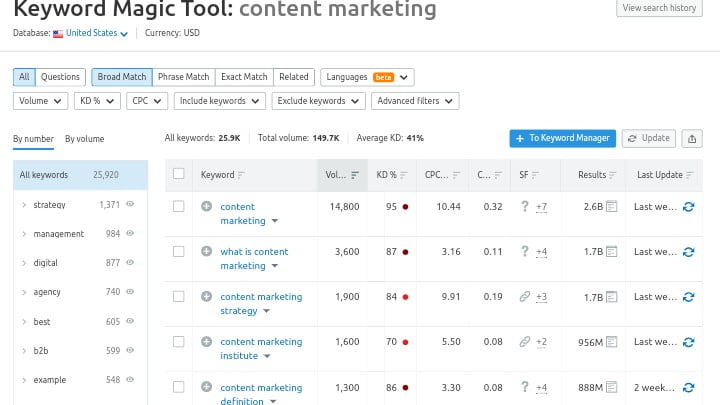
Filter through the Semrush Keyword Magic Tool results by volume, question, related keywords, and other metrics depending on your goal.
Once you find a keyword that works for you, click on it for more insights in keyword overview.
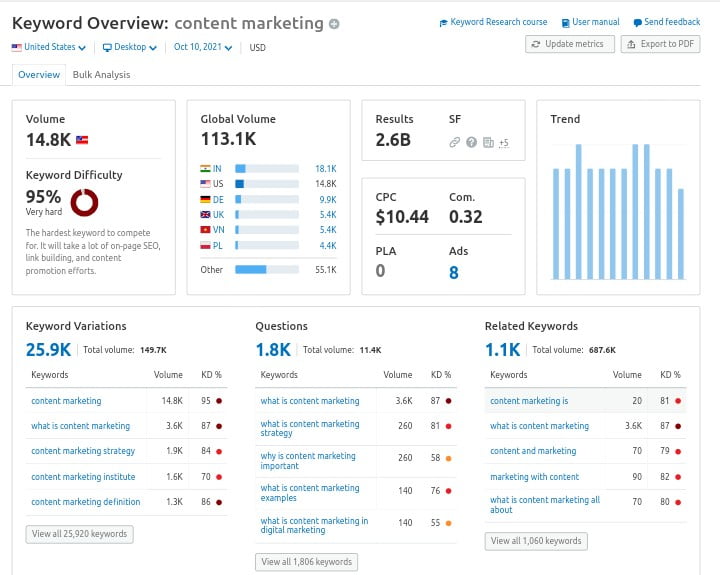
The Keyword Overview tool, gives you more detailed insights. From related keywords, questions, SERP and keyword difficult. So, when you’re writing with SEO in mind, you can further use related keywords to optimize your content.
As you can see from above, since our keyword ‘content marketing’ has a very high difficulty percentage. We can either look at it’s variations and related terms for one which is easy to rank.
3. Topic research
At this point, it’s time to expand your topic ideas based on existing information. The best part is, Semrush has a dedicated Topic Research tool. Which shows you existing topic related headlines and questions.
You can sort through these cards to find questions, existing articles and trending topics from your competitor’s site. The headline are mostly best performing content ideas with a first page dominance in search.
4. SEO Content Template
Staying on top of your competition online; is a task that demands consistent creation of high-quality content that ranks high in Google search. But how can you achieve this everytime you write a piece?
This is where Semrush’s SEO Content Template comes in.
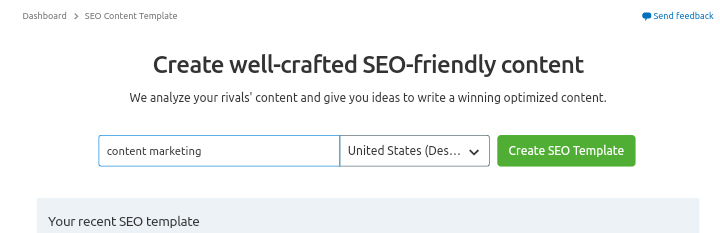
Within a few clicks, Semrush allows you to generate a blog template. That helps you create blog content or pages that are optimized for search engines.
The template is mainly an analysis of top 10 pages in Google search, based on your target keyword. It gives you recommendations on how to optimize; or what to include in your article to be among your top 10 rivals.
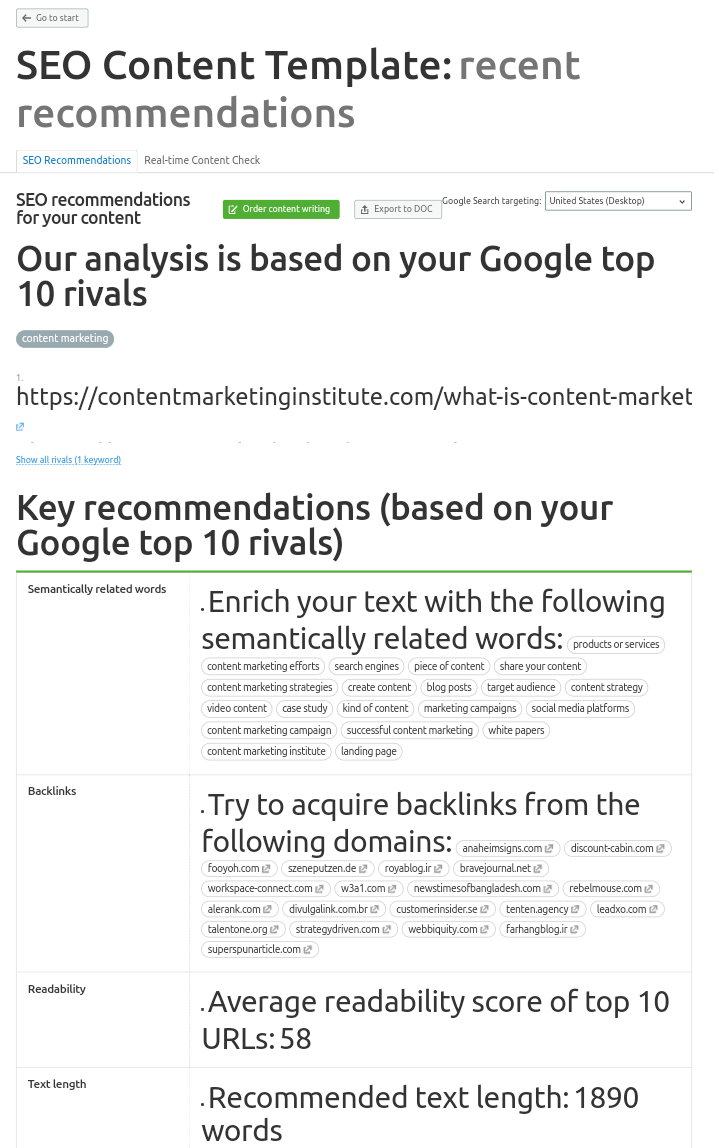
The generated template, groups the recommendations into back-links to aquire, text length, semantically related keywords to include and more.
Semrush Content Template parts
- Top 10 Pages rivals – A list of actual content from the Google top 10 rivals for your target keywords.
- Key Recommendations – shows you what you need to do in order to beat your top 10 rivals on Google. These recommendations are categorized into semantically related keywords, readability score and text length and backlinks.
- Basic Recommendations – the SEO Content Template basic recommendations. Are just reminders on how to optimize your page title, meta description and headings around your main keyword.
5. Write and Analyze content
Once you start writing, you can use the SEO Writing Assistant (SWA) which allows you to easily check your article’s SEO potential; readability, Tone of voice and originality of the content as you write.
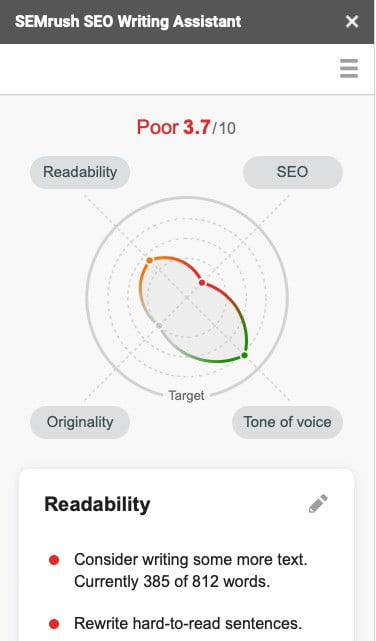
Semrush makes it even easier for you. See how you can Grow your organic traffic with SEO Writing Assistant Tool. Via its 7-day free trial here.
Benefits of Search Engine Optimized Content
Creating SEO-friendly content offers several benefits:
- Enhanced User Engagement: SEO-friendly content tends to be well-written, structured, and relevant to users. This can lead to increased user engagement, such as staying longer on the site, sharing, lower bounce rates, and more page views.
- Improved or increased Website Visibility: Optimized content helps search engines to understand the website. SEO-friendly content is more likely to rank higher in search engine results pages (SERPs) when people search for relevant keywords. This increased visibility usually results in more organic traffic.
- Higher Conversion rates: Well-optimized or targeted SEO content can attract users who are actively searching for products or information. This is because it can help to persuade visitors to take valuable actions, such as purchasing, subscribing, etc.
Technical Optimization
Having great content is only half the battle. In Zambia, where data costs are high and 4G coverage can be inconsistent, Technical SEO is what keeps your bounce rate low. Here is how I optimize Foshizo to ensure it loads for every Zambian user, regardless of their device.
1. Prioritizing Core Web Vitals
Google uses “Core Web Vitals” to measure how fast a page feels to a user. I focus specifically on LCP (Largest Contentful Paint). By ensuring my main images load in under 2.5 seconds, I prevent users on slower Zamtel or Airtel networks from abandoning the page.
2. Image Compression & Next-Gen Formats
Large photos are the biggest enemy of speed. I use WebP image formats instead of heavy JPEGs. This reduces image file sizes by up to 30% without losing quality, saving my readers’ data bundles and speeding up the “Time to First Byte.”
3. Mobile-First Responsiveness
Since over 80% of my traffic comes from smartphones, I design for the small screen first. This means:
- Touch-Ready Buttons: Ensuring “Download” or “Apply” buttons are large enough to tap easily.
- Font Legibility: Using a minimum of 16px font size so students don’t have to “pinch-to-zoom” to read career guides.
- Lightweight Themes: Using a fast-loading WordPress framework to minimize unnecessary code.
Wrapping Up
SEO is not a “one-and-done” task; it is a continuous process of providing value. By combining powerful tools like Semrush with a deep understanding of the Zambian search intent, you can build a platform that doesn’t just rank, but actually solves problems for your community.
Whether you are helping a student find a nursing school or guiding a business through PACRA registration, remember that quality is your best SEO strategy. Focus on the user, optimize for the slow network, and the rankings will follow.